VapoCept Ingredients: See Exactly What’s Inside Before You Buy
Every ingredient. Every disclosed dose. No proprietary blend. We break down what’s actually inside VapoCept — including what the formula can and cannot tell you before you order.
You’re considering VapoCept. Before you spend money, you want to know exactly what’s inside.
The formula discloses all six ingredients and their individual doses on the Supplement Facts label — no proprietary blend, no hidden amounts, no guessing. That puts you in a position to evaluate the composition with far more clarity than most supplements allow.
This analysis covers every ingredient: what it is, how much is included, the type of extract used when applicable, and what published research has explored about each compound. Where a dose is below the amounts commonly used in published studies, that context is included as well.
One important distinction applies throughout: a disclosed dose does not automatically mean it reproduces the results of studies done with the isolated ingredient. No clinical trial of the complete VapoCept product has been published. The ingredient-level context below helps explain why these compounds were selected, but it is not a substitute for clinical evidence on the product itself.
That’s exactly what this analysis is for.
For the full review covering pricing, guarantee, and our overall assessment, see our complete VapoCept review.
If you’re evaluating VapoCept before deciding whether to buy, you can see the complete offer — pricing, guarantee, and our overall assessment — here.
What’s in the VapoCept Formula?
VapoCept contains six individually disclosed ingredients. Each one is listed with its exact dose on the Supplement Facts label — no proprietary blend grouping them under a single combined weight. The formula is caffeine-free and contains no conventional stimulants.
Here is the actual label:
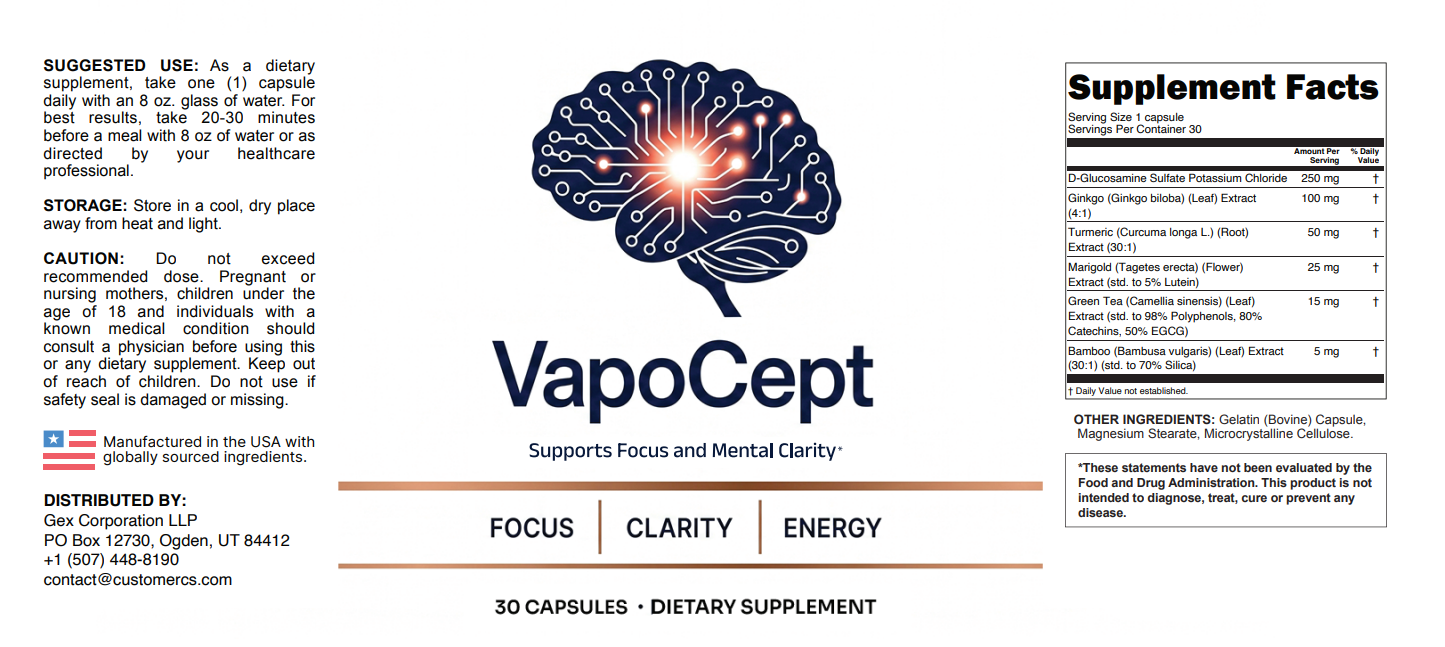
VapoCept Supplement Facts label — every ingredient and dose individually listed.
The six ingredients at a glance:
Ginkgo Biloba
100mg · 4:1 Extract
The lead ingredient in the formula. Studied in relation to cerebral circulation and cognitive function.
Turmeric
50mg · 30:1 Extract
A concentrated extract included for its studied antioxidant and inflammation-related properties.
D-Glucosamine Sulfate
250mg
The largest ingredient by weight. A non-botanical ingredient included alongside the formula’s botanical extracts.
Marigold Extract / Lutein
25mg · 5% Lutein
Studied for antioxidant activity and a potential role in brain and cognitive health.
Green Tea / EGCG
15mg · 98% Polyphenols · 50% EGCG
A highly concentrated polyphenol extract. Part of the formula’s antioxidant approach — not a caffeine source.
Bamboo Extract / Silica
5mg · 70% Silica
A complementary ingredient that supports the broader formula at a small dose.
That is the complete formula. Nothing else is hidden inside a blend, and nothing is left unaccounted for. Below, each ingredient is analyzed individually — what the published research has explored, how the dose compares to commonly studied amounts, and what role it plays in the overall formula.
VapoCept Ingredient Breakdown
Each of the six ingredients below is covered individually: what it is, why it appears in a brain-health formula, what published research has explored, and how the VapoCept dose compares with amounts used in that research.
Important context: published research on individual ingredients helps explain why they were selected, but it does not establish that the finished VapoCept formula produces the same results. No clinical trial of the complete product has been published.
Ginkgo Biloba — 100 mg (4:1 Extract)
Ginkgo Biloba is one of the most extensively researched botanical ingredients in the brain-health space. It has been used in traditional medicine for centuries and has been the subject of numerous modern clinical studies, particularly in relation to cerebral blood flow and cognitive function.
The core of the research interest is circulation: Ginkgo has been studied for its ability to support blood flow to the brain, which is relevant because adequate cerebral circulation delivers oxygen and nutrients to neurons. Published studies have also examined its relationship with memory, attention, and processing speed, with results that vary across study populations and protocols.
What the 4:1 extract ratio means: A 4:1 extract takes four parts of raw Ginkgo leaf and concentrates them into one part of extract. This means 100 mg of a 4:1 extract is derived from approximately 400 mg of raw leaf material. Extract ratios are used to concentrate the active compounds in the plant material.
VapoCept dose: 100 mg of a 4:1 Ginkgo Biloba extract.
Many of the most widely cited Ginkgo studies used standardized extracts at doses in the range of 120–240 mg per day. VapoCept’s 100 mg is below that range, though it is a concentrated 4:1 extract rather than a raw-leaf dose. The extract concentration is relevant because it determines how much of the active compounds you are actually getting — but extract ratios between products are not always directly comparable unless the standardization method is the same.
Ginkgo Biloba is the lead ingredient in the VapoCept formula and the one with the deepest research history. It is also the ingredient with the most important safety consideration: it may affect blood clotting and can interact with certain medications, which is covered in the side effects and safety analysis.
Turmeric — 50 mg (30:1 Extract)
Turmeric is a widely studied botanical, primarily researched for its active compound curcumin. The research interest centers on curcumin’s antioxidant properties and its studied role in inflammation-related pathways — both of which are relevant to long-term brain health.
What the 30:1 extract ratio means: A 30:1 concentration takes thirty parts of raw turmeric root and concentrates them into one part of extract. This is a high concentration ratio, which means the 50 mg in VapoCept is derived from a substantially larger amount of raw material. However, an extract ratio alone does not guarantee a specific curcumin content unless the extract is also standardized for curcuminoid percentage, which the VapoCept label does not specify.
VapoCept dose: 50 mg of a 30:1 Turmeric extract.
One well-known challenge with curcumin is bioavailability — the body does not absorb it efficiently on its own. Taking turmeric with food, particularly food containing fat, may improve absorption. Some supplement formulations pair curcumin with piperine (black pepper extract) to enhance bioavailability; VapoCept does not include piperine.
Turmeric is included in the formula alongside EGCG, which also has studied antioxidant properties. Together, they represent the antioxidant and inflammation-related layer of the VapoCept formula.
D-Glucosamine Sulfate — 250 mg
D-Glucosamine Sulfate is best known for its established use in joint-health supplements, where it has been extensively studied for cartilage and connective tissue support. Its inclusion in a brain-health formula is less conventional.
Some published research has explored glucosamine in the context of neuroprotection and inflammatory response in neural tissue, but this area of study is still developing. The evidence base for glucosamine’s role in cognitive function is not as established as it is for Ginkgo Biloba or curcumin.
VapoCept dose: 250 mg — the largest single ingredient by weight in the formula.
At 250 mg, D-Glucosamine is the heaviest ingredient in VapoCept by milligram count. Its role in this formula appears to be as a non-botanical complement to the herbal extracts, adding a structural-support compound from a different ingredient category. The neuroprotective research on glucosamine is still emerging, and it would be overstating the evidence to present this ingredient as a proven cognitive enhancer.
Marigold Extract / Lutein — 25 mg (5% Lutein)
Lutein is a carotenoid — a naturally occurring pigment found in marigold flowers, leafy greens, and other plant sources. It is best known for its role in eye health, but published research has also explored its presence in brain tissue, where it accumulates and acts as an antioxidant.
Understanding the label: The VapoCept label lists 25 mg of marigold extract standardized to 5% lutein. That means the extract provides approximately 1.25 mg of actual lutein per serving. It is important to distinguish between the total extract weight (25 mg) and the lutein content (~1.25 mg) — they are not the same number.
VapoCept dose: 25 mg marigold extract, providing approximately 1.25 mg of lutein.
Published studies that have examined lutein’s relationship with cognitive performance and brain health have used varying doses, often in the range of 10–20 mg of lutein itself. VapoCept’s ~1.25 mg of lutein is below those amounts. However, lutein is also obtained through diet (spinach, kale, eggs), so the supplement dose adds to whatever the user already gets from food.
Lutein brings an antioxidant element to the formula from a different compound class than the botanical extracts, which contributes to the formula’s variety of ingredient types.
Green Tea / EGCG — 15 mg (98% Polyphenols, 50% EGCG)
EGCG (epigallocatechin gallate) is a polyphenol found in green tea and one of the most studied natural antioxidant compounds. It has been researched for its antioxidant activity, its studied ability to cross the blood-brain barrier, and its potential relationship with neuroprotective pathways.
Understanding the label: VapoCept includes 15 mg of a green tea extract standardized to 98% polyphenols and 50% EGCG. That means approximately 7.5 mg of the extract is EGCG.
VapoCept dose: 15 mg green tea extract, providing approximately 7.5 mg of EGCG.
At approximately 7.5 mg of EGCG, this is a relatively small amount compared with the higher-dose EGCG supplementation used in some human studies. That makes it more appropriate to view EGCG here as a complementary component of the formula rather than a high-dose standalone ingredient.
An important clarification: Although this extract comes from green tea, the standardization is for polyphenols and EGCG — not caffeine. The VapoCept formula is described as caffeine-free and stimulant-free, and this green tea extract is included for its polyphenol content, not as a caffeine source.
Bamboo Extract / Silica — 5 mg (70% Silica)
Bamboo extract is included as a source of silica, a trace mineral that plays a role in connective tissue and vascular health. The VapoCept label specifies 70% silica, which means approximately 3.5 mg of silica from the 5 mg extract.
VapoCept dose: 5 mg bamboo extract (70% silica) — the smallest ingredient in the formula.
At 5 mg, this is a minimal dose. The published research on silica is primarily related to structural support for connective tissue and blood vessels rather than direct cognitive effects. In the context of this formula, bamboo silica appears to play a complementary role rather than serving as a primary cognitive ingredient. The available product information does not establish a direct cognitive benefit from this ingredient.
This is the ingredient with the least direct connection to brain health in the formula, and it is present at the smallest dose. Its contribution is best understood as complementary rather than central.
The section below puts all six ingredients side by side so you can see how each dose compares with the published research at a glance.
How the VapoCept Doses Compare With the Research
The table below puts all six ingredients side by side so you can see what VapoCept includes, what published research has explored, and what that context means for each ingredient’s role in the formula.
| Ingredient | VapoCept Dose | Research Context | What That Means |
|---|---|---|---|
| Ginkgo Biloba (4:1) | 100 mg | Many widely cited studies used standardized extracts at 120–240 mg/day | Below commonly studied extract doses, though VapoCept uses a concentrated 4:1 extract. Extract ratios are not always directly comparable across products. |
| Turmeric (30:1) | 50 mg | High concentration ratio (30:1), but curcuminoid % not specified on label | The 30:1 ratio provides concentration context, but without curcuminoid standardization the precise active-compound content cannot be calculated from the label alone. |
| D-Glucosamine | 250 mg | Primarily studied for joint health; neuroprotective research is still developing | The largest ingredient by weight. Its inclusion adds a non-botanical compound, though the cognitive evidence base is less established than for Ginkgo or curcumin. |
| Lutein (5%) | 25 mg extract (~1.25 mg lutein) |
Cognitive studies have used varying lutein doses, often 10–20 mg of lutein itself | The ~1.25 mg of lutein is modest compared with higher-dose studies. Lutein is also obtained through diet, so the supplement adds to dietary intake. |
| EGCG (50%) | 15 mg extract (~7.5 mg EGCG) |
Some human studies have used substantially higher EGCG doses | A complementary antioxidant component at a modest dose. Not a caffeine source — standardized for polyphenols. |
| Bamboo / Silica (70%) | 5 mg extract (~3.5 mg silica) |
Silica research focuses on connective tissue and vascular support, not cognition directly | The smallest ingredient. Plays a complementary role in the formula rather than a primary cognitive one. |
What the Table Shows
Ginkgo Biloba is the ingredient with the deepest research history in the formula. Its 100 mg dose is below many commonly cited standardized-extract study doses, though its 4:1 extract ratio provides additional concentration context. It is the cornerstone of the formula’s approach.
Turmeric’s 30:1 concentration ratio means the 50 mg extract is derived from a substantially larger amount of raw material. However, the label does not specify curcuminoid standardization, so the ratio should not be converted into a precise curcumin-equivalent dose.
Lutein provides approximately 1.25 mg from the 25 mg marigold extract at 5% standardization. EGCG provides approximately 7.5 mg from the 15 mg green tea extract at 50% EGCG. Both are modest amounts relative to higher-dose research and contribute to the formula’s antioxidant profile.
D-Glucosamine and bamboo silica are complementary ingredients with less direct evidence for cognitive effects. They add variety to the formula’s ingredient categories but are not the foundation of its brain-health positioning.
No clinical trial of the finished VapoCept formula has been published. The comparisons above are between individual ingredient doses and the published research on those ingredients — not evidence that VapoCept as a complete product delivers a specific result.
The practical takeaway: The formula is transparent enough that you can see exactly what you are getting. Some ingredients are present at modest amounts compared with higher-dose research, while others are standardized extracts whose concentration ratio provides additional context. The important point is that the label does not hide the amounts — and that puts the evaluation in your hands rather than behind a proprietary blend.
What Makes the VapoCept Formula Transparent?
Transparency and effectiveness are not the same thing — but transparency does make a formula easier to evaluate. What sets VapoCept’s label apart is that it gives you the information you need to research the formula on your own terms, rather than asking you to trust a single combined number.
Here is what the label actually provides:
01 — Every Ingredient Is Individually Listed
The Supplement Facts label identifies all six ingredients separately. You can see exactly what is in the formula without needing to decode a combined blend listing.
02 — The Amounts Are Disclosed
Each ingredient shows its individual dose in milligrams. That makes it possible to look up the ingredient, compare the listed amount with published research, and form your own assessment.
03 — Extract Details Are Shown When Available
For several ingredients the label goes further, listing concentration ratios and standardization percentages: Ginkgo at 4:1, Turmeric at 30:1, Lutein at 5%, EGCG at 50%, and Bamboo Silica at 70%. These details help you understand the type of extract used — though extract ratios and standardization percentages provide useful context, they do not by themselves establish potency, effectiveness, or equivalence to a clinical study dose.
04 — No Proprietary Blend
The six ingredients are not grouped under a single combined weight. When a formula uses a proprietary blend, you see the total milligrams for the group but not how much of each ingredient is included. VapoCept does not use that approach — every amount is visible on its own.
What Transparency Does Not Tell You
Transparency tells you what is in the formula and how much is listed on the label. It does not, by itself, prove that the finished VapoCept product produces a particular result.
Knowing each ingredient and its dose is genuinely useful — it puts you in a better position to evaluate the formula than a hidden blend ever could. But it is still important to keep the distinction clear: ingredient-level research is not the same thing as clinical evidence on the finished product. No published clinical trial of the complete VapoCept formula has been identified in this review.
What transparency does give you is the ability to see exactly what you are buying, verify the ingredients independently, and decide whether the formula aligns with what you are looking for.
What the VapoCept formula leaves out is also worth looking at — especially if you are trying to avoid caffeine and conventional stimulants.
What the VapoCept Formula Does Not Include
Looking at what a supplement leaves out can be just as useful as looking at the ingredients it contains — especially if you are specifically looking for a formula that does not rely on caffeine or conventional stimulants to produce its effect.
Here is what is absent from the VapoCept label:
01 — No Caffeine
The VapoCept formula is described as caffeine-free. Although the formula includes a green tea extract, that extract is standardized for polyphenols and EGCG — not used as a caffeine source. The product is not designed to deliver a caffeine-based energy effect.
02 — No Conventional Stimulants
The formula does not include conventional stimulant ingredients. Its six listed ingredients are instead a combination of botanical extracts, lutein, D-glucosamine, and silica.
03 — No Proprietary Blend
All six ingredients are individually disclosed with their own milligram amounts. The formula does not group them under a single combined blend weight.
04 — No Hidden Ingredient Doses
Every ingredient on the label includes an individual amount, so you can see the actual quantity of each one rather than trying to estimate from a combined total. That is the same disclosure level used throughout the ingredient analysis above.
Why This Matters If You Prefer a Non-Stimulant Formula
Some people actively prefer to avoid caffeine or stimulant-based supplements — not because those ingredients are inherently harmful, but because they are looking for a daily supplement routine that is not built around stimulation. That preference can make a non-stimulant formula more relevant when comparing products in the brain-health category.
VapoCept is positioned as a different type of formula. Its approach is built around individually disclosed botanical extracts, a carotenoid antioxidant, and complementary compounds rather than caffeine or conventional stimulants. That does not automatically make it more effective — but it does mean the formula is designed for a different kind of daily use than a stimulant-focused product.
If avoiding caffeine and stimulants is part of what you are looking for, the VapoCept label confirms that those ingredients are not part of the formula.
Of course, knowing what is in the formula — and what is not — still does not answer the most important evidence question: how much of that research actually applies to the finished VapoCept product?
Ingredient Research vs. The Finished VapoCept Product
Several ingredients in VapoCept have meaningful published research behind them — Ginkgo Biloba and curcumin in particular have been the subject of numerous human studies. That research is useful context, and it helps explain why these ingredients appear in a brain-health formula. But ingredient-level findings should not automatically be treated as proof that the complete VapoCept product produces the same result. Understanding the difference puts you in a stronger position to evaluate the formula honestly.
What Ingredient Research Can Tell You
Published ingredient research is valuable because it establishes a foundation. It can tell you what an ingredient has been studied for, which forms and extracts were used in those studies, what dose ranges have been investigated, and which areas of research have stronger or weaker evidence.
That is exactly the kind of context covered in the ingredient breakdown above. It helps you understand what each compound brings to the formula and whether the amounts on the VapoCept label are in a range that has been studied — or well below it.
What It Cannot Tell You
What ingredient research does not establish is that the same effect will occur in the finished VapoCept product. An individual ingredient studied in isolation, at a specific dose, in a controlled setting, does not automatically produce the same outcome when combined with five other ingredients at the doses listed on a different product’s label.
Specifically, ingredient studies do not confirm that the particular combination of six ingredients in VapoCept produces a specific outcome, that the VapoCept doses are equivalent to the doses used in a given clinical study, or that findings from controlled research guarantee an individual result. No published clinical trial of the complete VapoCept formula has been identified.
Why the VapoCept Formula Still Deserves a Closer Look
The absence of a finished-product clinical trial does not mean the formula cannot be evaluated. VapoCept provides enough label information to make a practical assessment possible:
- Every ingredient is individually identified
- Every dose is disclosed in milligrams
- Extract ratios and standardization percentages are provided where applicable
- The disclosed amounts can be compared with published ingredient research
- No ingredients are hidden behind a proprietary blend
- The formula contains no caffeine or conventional stimulants
That level of disclosure allows you to do exactly what this article has done: look at each ingredient, understand its role, and compare the dose with what has been studied. Most of the evaluation work is possible precisely because the label does not hide the details.
The practical takeaway: If you are evaluating VapoCept, the fairest way to look at the formula is not to ask whether ingredient studies “prove” VapoCept works. The better question is whether the disclosed ingredients, forms, and doses give you enough information to decide whether the formula fits what you are looking for.
VapoCept Ingredients FAQ
No. The VapoCept formula is described as caffeine-free. Although it contains a green tea extract, that extract is standardized for polyphenols and EGCG rather than being used as a caffeine source. The product is not designed to deliver a caffeine-based energy effect.
No. All six ingredients are individually listed with their own milligram amounts on the Supplement Facts label. Nothing is grouped under a single combined blend weight.
Ginkgo Biloba is the lead ingredient by the formula’s positioning and has the deepest research history among the six ingredients. It is listed at 100 mg of a 4:1 extract. Ginkgo has been widely studied in relation to cerebral circulation and cognitive function, though its inclusion in VapoCept does not establish that the finished product produces a specific cognitive result.
They vary. Ginkgo’s 100 mg is below many commonly cited standardized-extract study doses. Lutein provides approximately 1.25 mg and EGCG approximately 7.5 mg — both modest compared with some higher-dose research. Extract ratios and standardization percentages add important context, so simple milligram-to-milligram comparisons between the VapoCept label and a published study are not always sufficient. The dose comparison table earlier in this article covers each ingredient individually.
No published clinical trial of the complete VapoCept formula has been identified in this review. There is published research on several of the individual ingredients, and that research provides useful context for understanding the formula. However, ingredient-level research should not be presented as clinical proof that the finished product delivers a specific result.
What Should You Do With This Information?
You now know exactly what is inside VapoCept: the six ingredients, their listed doses, the extract details where provided, how those doses compare with published research, what the formula does not include, and the difference between ingredient research and evidence on the finished product.
Now the question changes. It’s no longer “What’s in this?” — it’s “Does the formula, the pricing, and the guarantee make sense for me?”
You’ve seen exactly what’s inside. Now see the full offer, current pricing, guarantee, and our overall assessment before you decide.
Continue Exploring the VapoCept Review
Each guide covers a specific topic so you can verify the details that matter most to you.